Tapestry Themes #13: Manchester's Enduring Impact on Science, Economics & Peace

Theme Thirteen: Manchester's Enduring Impact on Science, Economics & Peace

'Alan Mathison Turing (1912–1954) was a mathematician, computer scientist and codebreaker. Often dubbed ‘the father of modern computing’, Turing was based at The University of Manchester after his work with the British Intelligence Service at Bletchley Park during World War II. His contribution lead to the breaking of the German Enigma machine, an achievement that sees him chosen as the next face on the £50 note. Despite his remarkable achievements, as a gay man Turing was prosecuted for gross indecency in 1952, at a time when homosexuality was illegal in the UK. An inquest concluded his death from cyanide poisoning two years later was suicide. After a long-fought campaign, he was posthumously pardoned by HM The Queen in 2013.' (University of Manchester)

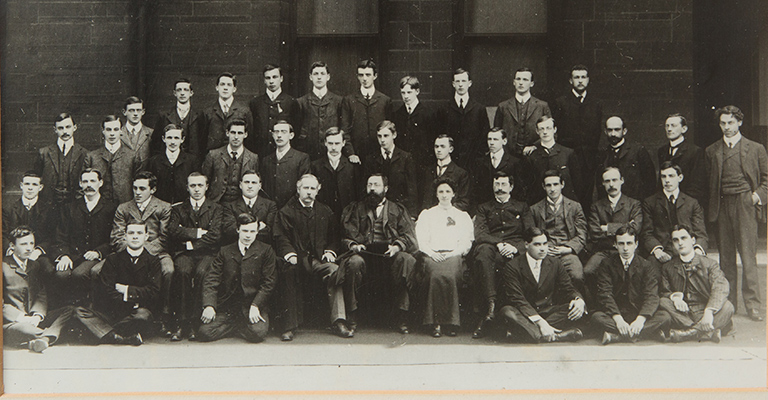
The team also found lots of information about Rona Robinson, a working-class woman who became the first woman to gain a first-class degree in Chemistry at the University of Manchester in 1905, then becoming a chemist and teacher. Rona very active in the women's suffrage movement and she went on to earn an MSc and became an industrial chemist, earning 3 patents.
'Rona Robinson’s story is striking not only because she was the first woman in the UK to earn a first-class degree in chemistry. Nor because she was an important cog in the suffragette movement. Her tale really resonates because she was an ordinary woman, from a working class background, who worked hard and fought for what she believed in.
“I think in science we tend to have a hero complex, we talk a lot about big names and big discoveries,” Dr Turner adds. “Many of our graduates will go on to have very ordinary lives in science, in industry, academia and other careers. We need to talk more about that.” - We couldn’t agree more.'